A year after a 15-year-old was killed crossing the street from a rec center in Provo, Utah, these #StrongCitizens got together to demonstrate how much safer (and more pleasant) Provo’s city’s streets could be if not designed for high speed traffic. Find out how they did it.
Read MoreThe reality for most of us is that “last mile” transportation options like e-scooters and e-boards, which imply connectivity to other forms of public transit, really mean nothing when public transit either isn’t adequate or doesn’t exist.
Read MoreRegina Portillo—Executive Director at City Makery in Laredo, Texas—shares how you can partner with local government to create and foster ideas for your community, including how to encourage people to share their ideas, how to encourage people to act on those ideas, and how to get local government involved in the process.
Giving valuable space in cities over to cars isn’t great for building walkable or productive places. But for now at least, our urban neighborhoods need some parking. This an area where thoughtful design can help us solve multiple problems at once.
Read MoreThe Strong Towns vision is a bottom-up revolution, one in which we rediscover the power of thinking small and acting locally. And the power of this vision transcends partisan politics as usual.
Read MoreWould you rather have a pizza, or the ingredients of a pizza arranged in separate piles? This analogy has something to teach us about the consequences of how we organize our cities.
Read MoreChris Arnade’s Dignity is a striking look into the faces of “back row” America—the poor, the homeless, the addicted, the forgotten. And it’s a challenge to us as a society to design policies that respond to their needs and values.
Read MoreHint: It has to do with donuts.
Read MoreThere is no such thing as a truly free market; the market exists within a system of rules and incentives. And in America today, that system privileges stability and efficiency at the federal level, at the expense of making our cities and towns fragile.
Read MoreVision Zero aims to end all traffic deaths. Can they do it on a national scale?
Read MoreIt’s easy to claim “We have too much parking” but to prove it? These Boston area planners were up to the challenge, surveying over 200 apartment buildings’ parking lots. What they found… might not shock you.
Read MoreThere’s a 30% chance your house will be worth less in five years. Homeownership is not the surefire investment vehicle it often gets advertised as.
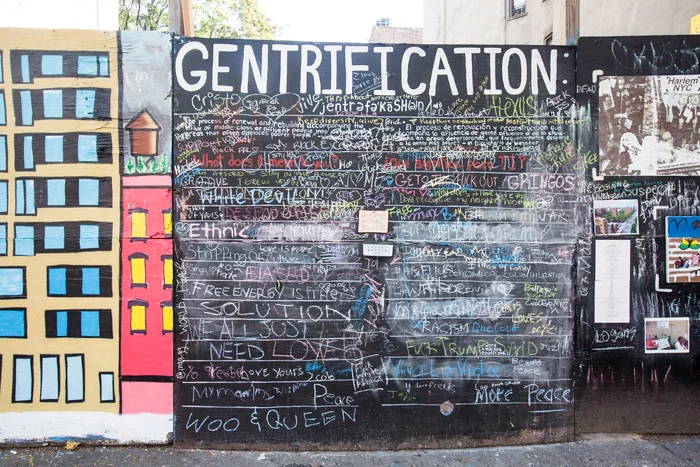
Read MoreTrue or False: Poor people are displaced a lot from gentrifying neighborhoods? True, says a new study from NYU that tracks where individual families moved—but mostly because of that first part: “Poor people are displaced a lot.” Period.
Read MoreLos Angeles, where the car is famously king, may have one of the best shots of any American city of becoming a car-optional place at scale—not just in a few trendy neighborhoods lucky enough to have good transit. Here’s why.
Read MoreThor Erickson—a longtime leader in the neighborhood and civic nonprofit sector—shares how you can use nonprofits to build strong neighborhoods in your own community, including how to bring your unique perspective to neighborhood investment, how to partner with your local government, and how to get your community behind your mission.
Cities evolve like ecological systems—a neighborhood, like a forest, has a life cycle. The fundamental question of planning needs to shift from “Should our neighborhoods change?” to “How should our neighborhoods change?”
Read MorePine Island, MN (population 3,000) has huge dreams, yet they can’t take care of their basic systems. Who pays the price?
Read MoreGiorgio Angelini’s documentary Owned chronicles the commoditization of homeownership in the U.S. and its fallout—both for those who were left out, and for those who were sold promises that we’re now struggling to fulfill.
Read MoreHow much road does your city have—and how much does it actually have the money to maintain? We compare “calories in” to “calories out” before we binge on ice cream; what if we took the same approach to our infrastructure budgets? One city did, and here’s what they found out.
Read MoreWhat if to build Strong Towns, we don’t just need to think outside of our partisan political boxes, but stop thinking of them as boxes at all?
Read More